<?xml version="1.0" encoding="utf-8"?><feed xmlns="http://www.w3.org/2005/Atom" ><generator uri="https://jekyllrb.com/" version="3.10.0">Jekyll</generator><link href="https://fkoehler.site/feed.xml" rel="self" type="application/atom+xml" /><link href="https://fkoehler.site/" rel="alternate" type="text/html" /><updated>2026-08-04T04:12:18-07:00</updated><id>https://fkoehler.site/feed.xml</id><title type="html">Felix Köhler’s Website</title><subtitle>My personal homepage.</subtitle><author><name>Felix Matteo Köhler</name></author><entry><title type="html">Hybridization of Neural Networks and Numerical Solvers in JAX with Differentiable Physics (Lecture and Practical Workshop)</title><link href="https://fkoehler.site/posts/2026/08/jax-ad-workshop/" rel="alternate" type="text/html" title="Hybridization of Neural Networks and Numerical Solvers in JAX with Differentiable Physics (Lecture and Practical Workshop)" /><published>2026-08-04T00:00:00-07:00</published><updated>2026-08-04T00:00:00-07:00</updated><id>https://fkoehler.site/posts/2026/08/jax-ad-workshop</id><content type="html" xml:base="https://fkoehler.site/posts/2026/08/jax-ad-workshop/"><![CDATA[<p>I was invited to give a lecture and practical sessions at the <a href="https://majsc2026.pages.math.unistra.fr/">Workshop on
Machine Learning and Automatic Differentiation in <code class="language-plaintext highlighter-rouge">JAX</code> for Scientific Computing
</a> hosted by the University of
Strasbourg in June 2026. For this, I presented a lecture on hybridization (i.e.,
how to marry neural networks and numerical solvers) as well as a practical
session on using the <a href="https://fkoehler.site/exponax/">Exponax</a> solver suite in
JAX for solving PDEs (concretely the Kolmogorov Flow), data assimilation,
inverse problems, and to build neural-hybrid correctors leading to a simplified
reproduction of the influential <a href="https://www.pnas.org/doi/10.1073/pnas.2101784118">ML-accelerated CFD paper by Kochkov et al.</a>. Thank you for having me!</p>

<p>All material can be found on <a href="https://github.com/Ceyron/hybridization-in-jax">this GitHub repository</a>.</p>

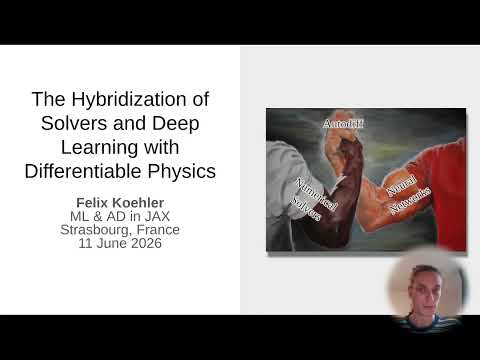
<p>Recording of the lecture:</p>

<p><a href="https://www.youtube.com/watch?v=carwzAOfuPE"><img src="https://img.youtube.com/vi/carwzAOfuPE/0.jpg" alt="Link to the lecture recording" /></a></p>

<p>Recording of the &#8220;zeroth&#8221; practical session on getting started with Exponax by solving the 2D Navier-Stokes Kolmogorov Flow:</p>

<p><a href="https://www.youtube.com/watch?v=I7ilrh6tbVc"><img src="https://img.youtube.com/vi/I7ilrh6tbVc/0.jpg" alt="Link to the &quot;zeroth&quot; practical session recording" /></a></p>

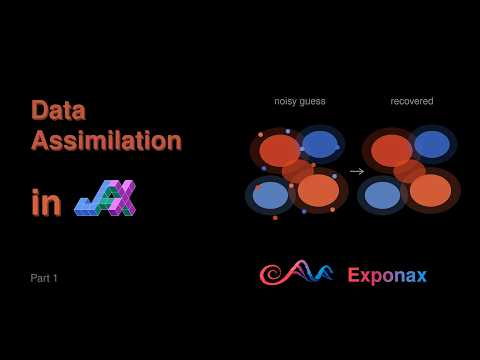
<p>Recording of the first practical session on data assimilation and inverse problems:</p>

<p><a href="https://www.youtube.com/watch?v=Tb3n52Ka4GM"><img src="https://img.youtube.com/vi/Tb3n52Ka4GM/0.jpg" alt="Link to the first practical session recording" /></a></p>

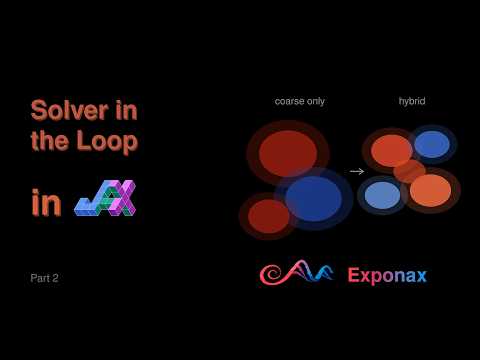
<p>Recording of the second practical session on building neural-hybrid correctors:</p>

<p><a href="https://www.youtube.com/watch?v=g1guv-fkIrQ"><img src="https://img.youtube.com/vi/g1guv-fkIrQ/0.jpg" alt="Link to the second practical session recording" /></a></p>

<p>Below is the abstract of the talk:</p>

<blockquote>
  <p>Neural Networks and Numerical Solvers for PDEs share strong similarities. Both
boil down to algebra operations that are mapped to primitives on hardware
accelerators. In this lecture, we will compare both from an algebraic and an
autodiff perspective, identifying advantages and weak points of both. After
discussing a range of possible ways neural networks can be used to approximate
physics simulations and how the two concepts can be married, we will settle on
full-field correction approaches as the most &#8220;deep-learning native way&#8221; of
hybridization. We will discuss nuances, technical insights, and practical JAX
implementations. The talk closes with an overview of case studies from the
literature.</p>
</blockquote>

<p>Below is the abstract of the practical sessions:</p>

<blockquote>
  <p>We will use the Exponax Fourier-spectral solver library
(https://github.com/Ceyron/exponax ) to perform fast simulation of the
Kolmogorov Flow, a well-studied test bed of 2D turbulence. By using the
solver&#8217;s differentiability, we can recover initial conditions and constitutive
parameters from data. The second half of this practical is concerned with
reproducing a simplified scenario of the influential &#8220;Machine
learning-accelerated computational fluid dynamics&#8221; paper by Kochkov et al.
(https://www.pnas.org/doi/10.1073/pnas.2101784118 ). This entails learning a
neural correction approach for a simulation on a coarser resolution. The
latter part of the exercise requires access to a GPU. The free T4 GPU from
Google Colab (e.g., conveniently accessible via the VS Code plugin:
https://github.com/googlecolab/colab-vscode ) is sufficient.</p>
</blockquote>]]></content><author><name>Felix Matteo Köhler</name></author><category term="PDE" /><summary type="html"><![CDATA[]]></summary></entry><entry><title type="html">From Numerical Simulators to Neural Emulators and Back (Talk at RISE ML Seminar)</title><link href="https://fkoehler.site/posts/2025/11/rise-talk/" rel="alternate" type="text/html" title="From Numerical Simulators to Neural Emulators and Back (Talk at RISE ML Seminar)" /><published>2025-11-14T00:00:00-08:00</published><updated>2025-11-14T00:00:00-08:00</updated><id>https://fkoehler.site/posts/2025/11/rise-talk</id><content type="html" xml:base="https://fkoehler.site/posts/2025/11/rise-talk/"><![CDATA[<p>I had the honor to be invited to the <a href="https://www.ri.se/en/learningmachinesseminars/felix-kohler-from-numerical-simulators-of-pdes-to-neural-emulators-and-back">RISE ML seminar
series</a>
and speak about my current research. You can find the <a href="https://www.youtube.com/watch?v=olpXyDARMJI&amp;list=PLqLiVcF3GKy1tuQFoDu5QKOM6S33t_4R1&amp;index=1">recording
here</a>
and the <a href="https://fkoehler.site/files/from_numerical_simulators_to_neural_emulators_and_back_at_RISE.pdf">slides
here</a>.</p>

<p>In it, I build a bigger narrative arc around the results from
<a href="https://tum-pbs.github.io/apebench-paper/">APEBench</a> and my recent NeurIPS 2025
paper on <a href="https://tum-pbs.github.io/emulator-superiority/">Neural Emulator Superiority</a>.</p>

<p>Below is the abstract of the talk:</p>

<blockquote>
  <p>The potential for computational speedups and tackling unsolved problems has
motivated the use of neural networks (NNs) for helping solve PDEs. In
particular, image-like models that operate on state-discrete representations
that approach time autoregressively gained popularity over the past years.</p>

  <p>In this talk, I will present a holistic perspective on learning autoregressive
neural emulators from simulated data, starting with the synthetic data
generation using classical numerical simulators, covering the training process
and ultimately investigating their benchmarking. Using a wide range of
experiments with different PDEs and neural architectures, I will highlight the
similarities between emulators and simulators. This shows how emulator
architectures were inspired by classical schemes for solving the laws of
nature and thereby inherit both their merits and limitations.</p>

  <p>Moreover, I will elaborate on the impact of reference data fidelity and
discuss a counterintuitive yet interesting finding when emulators can become
better than their training data source.</p>
</blockquote>]]></content><author><name>Felix Matteo Köhler</name></author><category term="PDE" /><summary type="html"><![CDATA[]]></summary></entry><entry><title type="html">My NeurIPS 2024 Paper: APEBench</title><link href="https://fkoehler.site/posts/2024/12/apebench/" rel="alternate" type="text/html" title="My NeurIPS 2024 Paper: APEBench" /><published>2024-12-02T00:00:00-08:00</published><updated>2024-12-02T00:00:00-08:00</updated><id>https://fkoehler.site/posts/2024/12/apebench</id><content type="html" xml:base="https://fkoehler.site/posts/2024/12/apebench/"><![CDATA[<p>🎉 I am happy to announce NeurIPS2024 paper: <a href="https://arxiv.org/abs/2411.00180">APEBench</a>.</p>

<p>🧵 Check out the <a href="https://tum-pbs.github.io/apebench-paper/">project page</a></p>

<p>👉 <a href="https://github.com/tum-pbs/apebench">Code</a></p>

<p>🤖 Or install via pip (requires JAX): <code class="language-plaintext highlighter-rouge">pip install apebench</code></p>

<p>In this <a href="https://bsky.app/profile/felix-m-koehler.bsky.social/post/3lhyknm5aw22e">Bluesky
thread</a>,
I summarize APEBench’s main contributions.</p>

<p>Check out the Twitter/X <a href="https://x.com/felix_m_koehler/status/1862034228642238872">thread with more
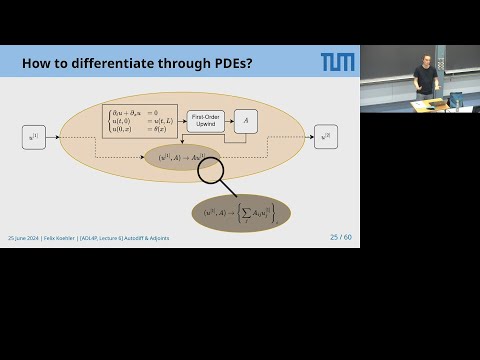
background and acknowledgements</a>.</p>]]></content><author><name>Felix Matteo Köhler</name></author><category term="PDE" /><summary type="html"><![CDATA[]]></summary></entry><entry><title type="html">Lecture: Automatic Differentiation &amp;amp; Adjoint Methods in Differentiable Physics</title><link href="https://fkoehler.site/posts/2024/07/autodiff-lecture/" rel="alternate" type="text/html" title="Lecture: Automatic Differentiation &amp;amp; Adjoint Methods in Differentiable Physics" /><published>2024-07-08T00:00:00-07:00</published><updated>2024-07-08T00:00:00-07:00</updated><id>https://fkoehler.site/posts/2024/07/autodiff-lecture</id><content type="html" xml:base="https://fkoehler.site/posts/2024/07/autodiff-lecture/"><![CDATA[<p>As part of our master course in <a href="https://ge.in.tum.de/teaching/">Advanced Deep Learning for Physics (IN2298)</a>, I gave a lecture on autodiff and adjoint methods. You can find the lecture slides <a href="https://fkoehler.site/files/autodiff_and_adjoints_lecture.pdf">here</a>. The lecture was recorded and is available on YouTube:</p>

<p><a href="https://www.youtube.com/watch?v=N7nVoyR0qO4"><img src="https://img.youtube.com/vi/N7nVoyR0qO4/0.jpg" alt="Link to the YouTube video" /></a></p>

<p>In it, I cover:</p>

<ol>
  <li>A functional (JAX/Julia-inspired) viewpoint on autodiff in terms of Jvp/Pushforward and vJp/Pullback</li>
  <li>Identifying hierarchy levels in autodiff (scalar-mode, vector-mode, continuous-mode)</li>
  <li>A comparison of Optimize-then-Discretize (OtD) vs. Discretize-then-Optimize (DtO)</li>
  <li>Special aspects of differentiable physics like differentiating over linear and nonlinear solvers</li>
  <li>Advanced topics and recent research directions</li>
</ol>]]></content><author><name>Felix Matteo Köhler</name></author><category term="autodiff" /><category term="adjoint" /><category term="differentiable physics" /><category term="PDE" /><summary type="html"><![CDATA[]]></summary></entry><entry><title type="html">My new Website and Blog</title><link href="https://fkoehler.site/posts/2023/02/my-new-website-and-blog/" rel="alternate" type="text/html" title="My new Website and Blog" /><published>2023-02-26T00:00:00-08:00</published><updated>2023-02-26T00:00:00-08:00</updated><id>https://fkoehler.site/posts/2023/02/my-blog</id><content type="html" xml:base="https://fkoehler.site/posts/2023/02/my-new-website-and-blog/"><![CDATA[<p>This is my new website and blog. I am still working on it, but it is already online. I will post more information about it soon.</p>

<p>Quick test on the math mode: $\int_0^1 x^2 dx$ inline</p>

<p>and full line:</p>

\[\int_0^1 x^2 dx\]

<p>And the code snippet:</p>

<div class="language-python highlighter-rouge"><div class="highlight"><pre class="highlight"><code><span class="kn">import</span> <span class="nn">numpy</span> <span class="k">as</span> <span class="n">np</span>
<span class="kn">import</span> <span class="nn">matplotlib.pyplot</span> <span class="k">as</span> <span class="n">plt</span>

<span class="n">x</span> <span class="o">=</span> <span class="n">np</span><span class="p">.</span><span class="n">linspace</span><span class="p">(</span><span class="mi">0</span><span class="p">,</span> <span class="mi">1</span><span class="p">,</span> <span class="mi">100</span><span class="p">)</span>
<span class="n">y</span> <span class="o">=</span> <span class="n">x</span><span class="o">**</span><span class="mi">2</span>

<span class="n">plt</span><span class="p">.</span><span class="n">plot</span><span class="p">(</span><span class="n">x</span><span class="p">,</span> <span class="n">y</span><span class="p">)</span>
<span class="n">plt</span><span class="p">.</span><span class="n">show</span><span class="p">()</span>
</code></pre></div></div>]]></content><author><name>Felix Matteo Köhler</name></author><category term="a tag?" /><summary type="html"><![CDATA[This is my new website and blog. I am still working on it, but it is already online. I will post more information about it soon.]]></summary></entry></feed>