Hybridization of Neural Networks and Numerical Solvers in JAX with Differentiable Physics (Lecture and Practical Workshop)
Published:
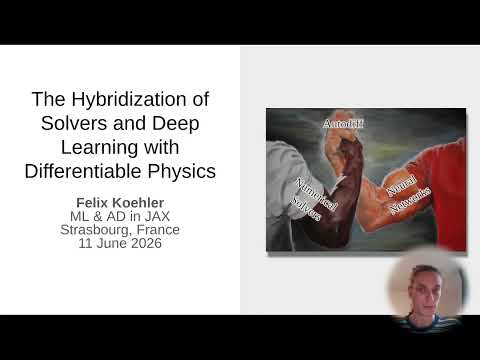
I was invited to give a lecture and practical sessions at the Workshop on Machine Learning and Automatic Differentiation in JAX for Scientific Computing hosted by the University of Strasbourg in June 2026. For this, I presented a lecture on hybridization (i.e., how to marry neural networks and numerical solvers) as well as a practical session on using the Exponax solver suite in JAX for solving PDEs (concretely the Kolmogorov Flow), data assimilation, inverse problems, and to build neural-hybrid correctors leading to a simplified reproduction of the influential ML-accelerated CFD paper by Kochkov et al.. Thank you for having me!
All material can be found on this GitHub repository.
Recording of the lecture:
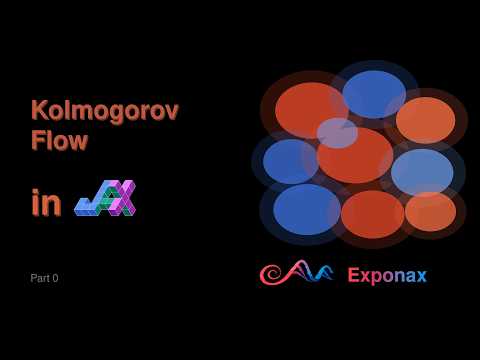
Recording of the “zeroth” practical session on getting started with Exponax by solving the 2D Navier-Stokes Kolmogorov Flow:
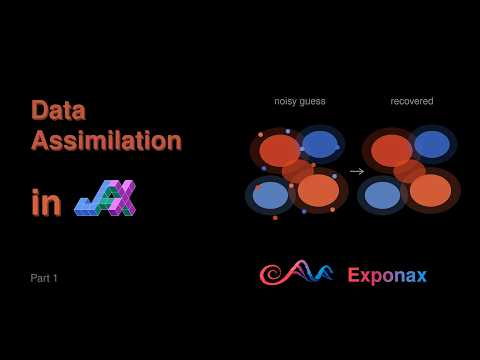
Recording of the first practical session on data assimilation and inverse problems:
Recording of the second practical session on building neural-hybrid correctors:
Below is the abstract of the talk:
Neural Networks and Numerical Solvers for PDEs share strong similarities. Both boil down to algebra operations that are mapped to primitives on hardware accelerators. In this lecture, we will compare both from an algebraic and an autodiff perspective, identifying advantages and weak points of both. After discussing a range of possible ways neural networks can be used to approximate physics simulations and how the two concepts can be married, we will settle on full-field correction approaches as the most “deep-learning native way” of hybridization. We will discuss nuances, technical insights, and practical JAX implementations. The talk closes with an overview of case studies from the literature.
Below is the abstract of the practical sessions:
We will use the Exponax Fourier-spectral solver library (https://github.com/Ceyron/exponax ) to perform fast simulation of the Kolmogorov Flow, a well-studied test bed of 2D turbulence. By using the solver’s differentiability, we can recover initial conditions and constitutive parameters from data. The second half of this practical is concerned with reproducing a simplified scenario of the influential “Machine learning-accelerated computational fluid dynamics” paper by Kochkov et al. (https://www.pnas.org/doi/10.1073/pnas.2101784118 ). This entails learning a neural correction approach for a simulation on a coarser resolution. The latter part of the exercise requires access to a GPU. The free T4 GPU from Google Colab (e.g., conveniently accessible via the VS Code plugin: https://github.com/googlecolab/colab-vscode ) is sufficient.